Pages

17 December 2013

The Advent Antiphons: O Adonai

Scenes from life of Moses, Ingeborg Psalter (Denmark, 13th c.)
O Adonai, et dux domus Israel,
qui Moysi in igne flammae rubi apparuisti,
et ei in Sina legem dedisti:
veni ad redimendum nos in brachio extento.

O Adonai, and leader of the House of Israel,
who appeared to Moses in the fire of the burning bush
and gave him the law on Sinai:
Come and redeem us with an outstretched arm.


“O LORD my God you are very great” (Ps 104:1).  Dwelling “in unapproachable light,” you make “flame and fire your ministers,” as when your messenger appeared to Moses “in a flame of fire out of a bush” (1 Tim 6:16, Ps 104:4; Ex 3:2).  When you appeared in the blazing unburnt bush, revealing yourself as the God of Abraham, the God of Isaac, and the God of Jacob, Moses was afraid to look at you (cf. Ex 3:6).  When you gave him the law on Sinai, “in cloud and majesty and awe,” your appearance was “like a devouring fire on the top of the mountain in the sight of the people of Israel” (Ex 24:17).  You are very great, O LORD: “in your light we see light” (Ps 36:9).

Fire and light are apt figures for you, O Lord, for your life blazes out in uncontainable freedom.  Your unsayable, mysterious Name gives us no handle on you.  “I AM WHO I AM,” you say, “I will be gracious to whom I will be gracious, and will show mercy on whom I will show mercy” (Ex 3:14; 33:19).  In your freedom, you show that your “unfamiliar name” is love. [1]

In love, O LORD, you observed the misery of your people in Egypt, and came to your people to set them free from their oppressors.  You "brought Israel out with silver and gold" because you remembered your covenant to Abraham; you brought your people out with joy and your chosen ones with singing, giving them the lands of the nations that they might keep your statutes and observe your righteous laws (Ps. 105:37, 42–45).  

O LORD, your steadfast love endures forever (cf. Ps 136).  Come again and deliver your poor ones who suffer injustice.  Give us the grace to “be docile and attentive to the cry of the poor and to come to their aid.” [2]  Come and redeem your people.  “Stir up your power, O Lord, and with great might come among us; and, because we are sorely hindered by our sins, let your bountiful grace and mercy speedily help and deliver us.” [3]

* English translation from the Church of England’s Advent seasonal resource.
[1] Cf. T.S. Eliot, “Little Gidding,” IV.
[2] Francis I, Apostolic Exhortation, Evangelii Gaudium, 187. 
[3] Collect for the Third Sunday of Advent, The Book of Common Prayer.

16 December 2013

The Advent Antiphons: O Sapientia

Detail of drawing of Temple of Wisdom,
with the Virgin, Christ, and the gifts of the Holy Spirit
(Germany, 12th c.) [British Library]
O Sapientia, quae ex ore Altissimi prodisti,
attingens a fine usque ad finem fortiter,
suaviter disponensque omnia:
veni ad docendum nos viam prudentiae.

O Wisdom, coming forth from the mouth of the Most High,
reaching from one end to the other mightily,
and sweetly ordering all things:
Come and teach us the way of prudence.


Lord Jesus Christ, Son of the Father, you are “the wisdom and power of God” (1 Cor 1:24), because you are “wisdom from wisdom” just as you are light from light and God from God, one wisdom, one light, one God with the Father and the Holy Spirit. [1]  

You are the wisdom whom the Father eternally utters as his Word.  Through you the worlds were created, “all things in heaven and on earth…, things visible and invisible, whether thrones or dominions or rulers or powers—all things have been created through” you and for you (Col 1:16).  You are the Word in whom “all things hold together” (Col 1:16, 17), the wisdom of whom it is written,
     She reaches mightily from one end of the earth to the other,
     and she orders all things well. (Wis 8:1) 

By you the Father has spoken to us in these last days (Heb 1:2), when you, the Word, “became flesh and lived among us” (Jn 1:14).  You “declare the Father as he is, because you are yourself just like that, being exactly what the Father is insofar as you are wisdom…” [2]  Because you are the exact “image of the invisible God” (Col 1:15), whoever has seen you has seen the Father (Jn 14:9).

You, Christ, “became for us wisdom from God, and righteousness and sanctification and redemption” (1 Cor 1:30).  You become wisdom for us, our wisdom, when we turn to you and you enlighten us; you are made wisdom in the sense that “we turn to you in time...in order to abide with you for ever.” [3]  You became for us the way to the Father.  When we imitate you by living wisely, you refashion us to your likeness; when we walk in you, we move toward you, who are ever with the Father and the Holy Spirit. [4]

Come, teach us the way of wisdom in the “foolishness” of your cross, “for God’s foolishness is wiser than human wisdom, and God’s weakness is stronger than human strength” (1 Cor 1:25).


* English translation from the Church of England’s Advent seasonal resource, one of an abundance of supplementary seasonal material in Common Worship.
[1] Cf. Augustine, Trin. 7.1.2.
[2] Augustine, Trin. 7.3.4, emphasis added and pronouns changed to second person.  ET:  Augustine, The Trinity. The Works of Saint Augustine. Trans. Edmund Hill (New City Press, 1991).
[3] Ibid., pronouns changed to second person.
[4] Cf. Augustine, Trin. 7.3.5.

15 December 2013

The Advent Antiphons

Detail of the Magnificat Antiphons
for Vespers in the 4th week of Advent,
“The Poissy Antiphonal”, f. 30r (France, 1335–45)
[State Library of Victoria]
When I was growing up, most years during the weeks before Christmas my parents would somehow get my siblings and me to stay after dinner at the table for devotions around the Advent wreath.  About the only thing I remember about these times is that we would sing, “O come, O come, Emmanuel."  I've always liked this hymn, with its plaintive tune and hopeful words—words which come from a set of ancient Latin prayers known as the "O Antiphons."

Since at least the eighth century, western Christians following Roman use have sung the O Antiphons before and after the Magnificat at Vespers on the seven days preceding Christmas Eve (December 17–23).  These antiphons, or refrains, all beginning “O…”, invoke the Messiah with titles and images derived primarily from the Old Testament.  Through the O Antiphons, the church calls to her Savior, “Veni, Come!”  In reverse order, the initials of each invocation (Emmanuel, Rex, Oriens, Clavis, Radix, Adonai, Sapientia) form an acrostic that spells out the Latin phrase, ero cras, in which the church hears the response of Christ, “I shall be [with you] tomorrow."

The medieval rite of Salisbury Cathedral (also known as “Sarum Use”), which was widely followed in the English church before the Reformation, began the O Antiphons on December 16, providing an additional antiphon (O Virgo virginum, “O Virgin of Virgins) for Christmas Eve.  The Calendar of the 1662 Book of Common Prayer possibly reflects this usage in designating December 16 as O Sapientia (O Wisdom).

As a devotion for the last days of Advent (with partial inspiration from here), I have prepared a series of reflections—with visual and musical pairings—on each antiphon following the old English use.

                              16 December — O Sapientia

                              17 December — O Adonai

                              18 December — O Radix Jesse

                              19 December — O Clavis David

                              20 December — O Oriens

                              21 December — O Rex gentium

                              22 December — O Emmanuel

                              23 December — O Virgo virginum


Sources:
“O-Antiphons”, The Oxford Dictionary of the Christian Church, eds. F.L. Cross and E.A. Livingstone (2nd ed; Oxford, 1983).
M. Hugo, "O Antiphons," New Catholic Encyclopedia, Vol. 10 (2nd ed; Gale, 2003).

08 December 2013

On an Advent Collect

Missal, with the text for Advent (Durham, England, 14th c.)
"Almighty God, give us grace to cast away the works of darkness, and put on the armor of light, now in the time of this mortal life in which your Son Jesus Christ came to visit us in great humility; that in the last day, when he shall come again in his glorious majesty to judge both the living and the dead, we may rise to the life immortal; through him who lives and reigns with you and the Holy Spirit, one God, now and for ever. Amen."

The 1662 Book of Common Prayer appoints the collect for the First Sunday of Advent to be repeated every day in Advent until Christmas Eve.  The prayer thus sets the tone for the whole season—indeed, for the whole liturgical year—and invites reflection.

“Give us grace to cast away the works of darkness, and put on the armor of light”
The prayer opens with language taken from Romans 13:12, part of the Epistle lesson (Rom 13:11–14) associated since at least the medieval period with the first Sunday of Advent and retained in the first year of the three-year cycle of the current Revised Common Lectionary.  (The lesson appears, for example, in the 14th-century English missal shown in the image above.)  The English reformers expanded the lesson to begin with verse 8: “Owe no one anything, except to love one another; for the one who loves another has fulfilled the law.”  

The expanded lection helps us see that to cast away the works of darkness and to put on the armor of light is nothing more nor less than to love.  For St. Paul connects the love command (vv. 8–10) to the section about knowing the time (vv. 11–14) with a simple kai touto, “and this.”  Thus, St. Paul effectively says in verse 11 that we are to love, knowing that it is time to walk in the light of the coming day of salvation.  Because the night is far spent, because the reign of sin and death is near its end, we are to put on the armor (hopla, lit., “weapons”) of light (v. 12).  We are to no longer give our selves as “instruments of unrighteousness” (hopla adikias), but to present our bodies to God as “instruments of righteousness” (hopla dikaisoynes) (6:13), as “ a living sacrifice” (12:1).  In short, we are to “put on the Lord Jesus Christ” (13:14), to immerse ourselves in the life of the risen Lord.  United with our Lord in a death like his in baptism, we are to “walk in newness of life,” living to God, considering ourselves “alive to God in Christ Jesus” (cf. Rom 6:4–11).  Knowing the time, we are to “walk in love, as Christ loved us and gave himself for us, an offering and sacrifice to God.” (Eph 5:2).

“Now in the time of this mortal life in which your Son Jesus Christ came to visit us in great humility”
Now is when we are to love one another.  Like St. Paul, the collect assumes that we know the time, “that now it is high time to awake out of sleep: for now is our salvation nearer than when we believed.  The night is far spent, the day is at hand” (Rom 13:11–12a, KJV).  Now is the time of the shadows before the coming dawn, a time when the continuing effects of sin and death require from us sober watchfulness and mutual encouragement if we are to not be conformed to this devastated world, but transformed by the renewing of our minds (12:2).

Advent Prayers in "The Leofric Missal" (England, 9th–11th c.)
Now we are to let our minds be conformed to of Christ Jesus, “who, though he was in the form of God, did not regard equality with God as something to be exploited, but emptied himself, taking the form of a slave, being born in human likeness. And being found in human form, he humbled himself and became obedient to the point of death— even death on a cross” (Phil 2:6–8).

“That in the last day, when he shall come again in his glorious majesty to judge both the living and the dead, we may rise to the life immortal”*
The prayer concludes by directing our attention to the second advent of our Lord, to the day when “at the name of Jesus every knee should bend, in heaven and on earth and under the earth, and every tongue should confess that Jesus Christ is Lord, to the glory of God the Father” (Phil 2:10–11).  In light of his coming, “what sort of people ought [we] to be in living lives of holiness and godliness, waiting for and hastening the coming of the day of God?” (2 Pt 3:12)  We are called to be a people whose lives of love point to the coming renewal of creation, “where righteousness is at home” (2 Pt 3:13).  We are called to be a people whose obedience to the Lord Jesus proclaims his sovereignty in a world that does not yet acknowledge Christ as King.


* The collect’s aspiration clause corresponds closely to a post-communion prayer in the Gelasian Sacramentaries of the 8th century, a family of western service books from which, together with the Gregorian Sacramentaries, the Roman Missal derives.  (An early example of the prayer is found in the “Leofric Missal,” brought to England in the 10th or 11th century.  See the last prayer, beginning Preces populi tui, in the righthand image above.)  That prayer translates roughly as “...that they may rejoice at the advent of your Only-begotten according to the flesh, may at the second advent, when he shall come in his majesty, receive the reward of eternal life” (Trans. Marion J. Hatchett, Commentary on the American Prayer Book [HarperOne, 1995], p. 165).

21 November 2013

"Read, Mark, Learn, and Inwardly Digest": On Eating Scripture

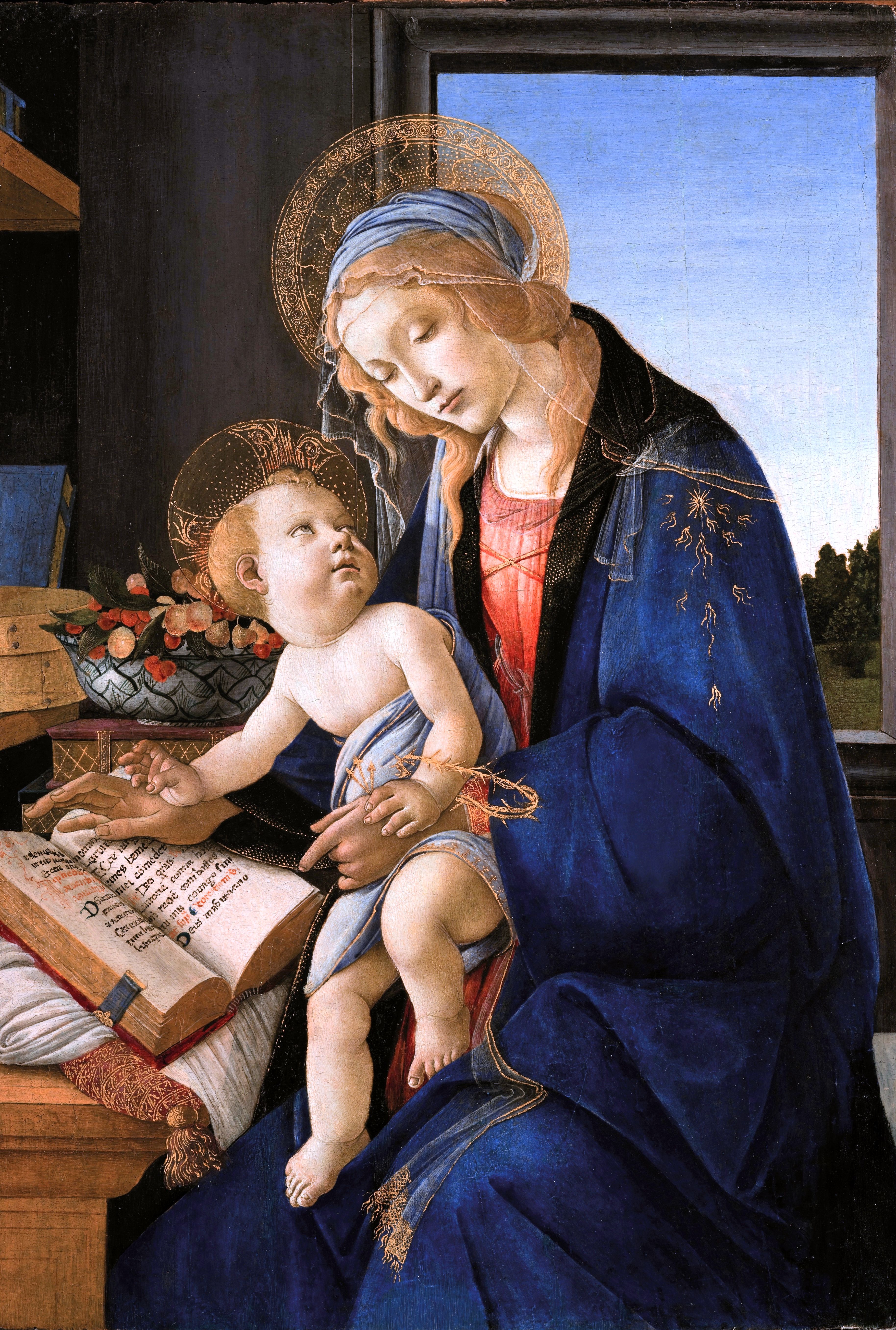
Sandro Botticelli, "Madonna of the Book" (ca. 1483)
“BLESSED Lord, who hast caused all holy Scriptures to be written for our learning; Grant that we may in such wise hear them, read, mark, learn, and inwardly digest them, that by patience and comfort of thy holy Word, we may embrace, and ever hold fast, the blessed hope of everlasting life, which thou hast given us in our Saviour Jesus Christ. Amen.”
The collect for this the penultimate Sunday of ordinary time was composed for the first Book of Common Prayer in 1549.  The prayer was originally paired with the readings for the second Sunday of Advent, and it draws its language from the epistle lesson for that day: Romans 15:4–13.  There we read, “Whatever was written in former days was written for our instruction, that by steadfastness and by the encouragement of the scriptures we might have hope” (v. 4).  The acknowledgement clause of the collect (“who has caused all holy Scriptures, etc.”) corresponds to the first part of St. Paul’s sentence, and the collect’s aspiration clause (“that, by patience and the comfort of they holy Word, we may, etc.”) to the second part.  (The last phrase of the collect makes reference to Colossians 1:27.)  In the collect’s petition clause (“grant that we may, etc.”), we ask for what we need in order to maintain hope.  We ask God—“the God of steadfastness and encouragement”, “the God of hope” (Rom 15:5, 13)— for what we need to be the sort of people who can take courage from Holy Scripture and so hold steadfast to our hope in Christ.  And what we need is to truly hear the words of Scripture.  Accordingly, we pray for the grace to hear the words of Scripture, “so that we may abound in hope by the power of the Holy Spirit” (Rom 15:13).

The collect recognizes, with the long tradition of the church, that hearing the Word of God in the manifold words of Scripture is demanding.  To drive the point home, the collect glosses “hear” with a concatenation of verbs: “read, mark, learn, and inwardly digest.”  Scripture does not instruct us in hope automatically; rather, we must chew, ingest and ruminate on the words of Scripture in order to discern in them the comfort (in the sense of the late Latin confortare, “greatly strengthen”) of God’s holy Word.  What is offered to us in the words of Scripture sometimes does not seem palatable, but when we “inwardly digest” it we will, like the prophet Ezekiel, find it sweet as honey in our mouths (Ezek. 3:3).  We will discover the sweetness of Christ, “for both in the Old and New Testament everlasting life is offered to Mankind by Christ, who is the only Mediator between God and Man, being both God and Man.”*  Tasting for ourselves the goodness of the Word become flesh increases our appetite for our Lord.

In the end, learning to hear the Word is a matter of love.  “Hunger for the Word is a need of love. […] It is the discovery of the mystery of a Person deeply loved, in whom every truth comes together like the lines on his face.  He is the Truth, and every text of Scripture speaks of him.”**  Reading, marking, learning, and inwardly digesting the words of Scripture is a primary way we “seek his face always” (Ps. 105:4).  Thus, Augustine exhorts us in this life of our pilgrimage to “treat the Scripture of God as the face of God.  Melt in its presence.”***

*Article VII, Articles of Religion.
** Mariano Magrassi, Praying the Bible: An Introduction to Lectio Divina, trans. Edward Hagman (Liturgical Press, 1998), p. 65.
*** Augustine, Sermon 22.7, PL 38.  Translation from Robert Louis Wilken, The Spirit of Early Christian Thought: Seeking the Face of God (Yale, 2003), p. 50.