Pages

21 November 2013

"Read, Mark, Learn, and Inwardly Digest": On Eating Scripture

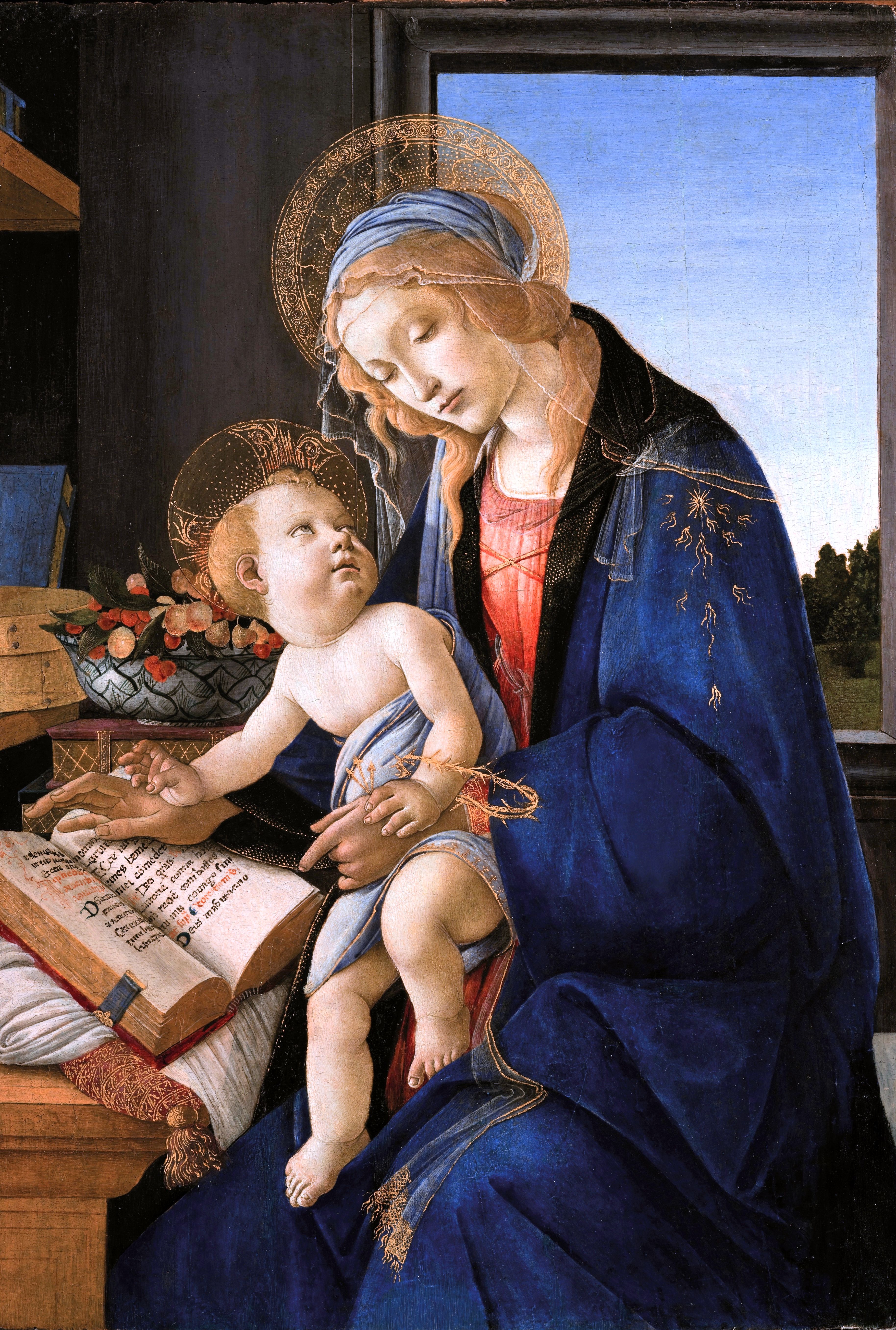
Sandro Botticelli, "Madonna of the Book" (ca. 1483)
“BLESSED Lord, who hast caused all holy Scriptures to be written for our learning; Grant that we may in such wise hear them, read, mark, learn, and inwardly digest them, that by patience and comfort of thy holy Word, we may embrace, and ever hold fast, the blessed hope of everlasting life, which thou hast given us in our Saviour Jesus Christ. Amen.”
The collect for this the penultimate Sunday of ordinary time was composed for the first Book of Common Prayer in 1549.  The prayer was originally paired with the readings for the second Sunday of Advent, and it draws its language from the epistle lesson for that day: Romans 15:4–13.  There we read, “Whatever was written in former days was written for our instruction, that by steadfastness and by the encouragement of the scriptures we might have hope” (v. 4).  The acknowledgement clause of the collect (“who has caused all holy Scriptures, etc.”) corresponds to the first part of St. Paul’s sentence, and the collect’s aspiration clause (“that, by patience and the comfort of they holy Word, we may, etc.”) to the second part.  (The last phrase of the collect makes reference to Colossians 1:27.)  In the collect’s petition clause (“grant that we may, etc.”), we ask for what we need in order to maintain hope.  We ask God—“the God of steadfastness and encouragement”, “the God of hope” (Rom 15:5, 13)— for what we need to be the sort of people who can take courage from Holy Scripture and so hold steadfast to our hope in Christ.  And what we need is to truly hear the words of Scripture.  Accordingly, we pray for the grace to hear the words of Scripture, “so that we may abound in hope by the power of the Holy Spirit” (Rom 15:13).

The collect recognizes, with the long tradition of the church, that hearing the Word of God in the manifold words of Scripture is demanding.  To drive the point home, the collect glosses “hear” with a concatenation of verbs: “read, mark, learn, and inwardly digest.”  Scripture does not instruct us in hope automatically; rather, we must chew, ingest and ruminate on the words of Scripture in order to discern in them the comfort (in the sense of the late Latin confortare, “greatly strengthen”) of God’s holy Word.  What is offered to us in the words of Scripture sometimes does not seem palatable, but when we “inwardly digest” it we will, like the prophet Ezekiel, find it sweet as honey in our mouths (Ezek. 3:3).  We will discover the sweetness of Christ, “for both in the Old and New Testament everlasting life is offered to Mankind by Christ, who is the only Mediator between God and Man, being both God and Man.”*  Tasting for ourselves the goodness of the Word become flesh increases our appetite for our Lord.

In the end, learning to hear the Word is a matter of love.  “Hunger for the Word is a need of love. […] It is the discovery of the mystery of a Person deeply loved, in whom every truth comes together like the lines on his face.  He is the Truth, and every text of Scripture speaks of him.”**  Reading, marking, learning, and inwardly digesting the words of Scripture is a primary way we “seek his face always” (Ps. 105:4).  Thus, Augustine exhorts us in this life of our pilgrimage to “treat the Scripture of God as the face of God.  Melt in its presence.”***

*Article VII, Articles of Religion.
** Mariano Magrassi, Praying the Bible: An Introduction to Lectio Divina, trans. Edward Hagman (Liturgical Press, 1998), p. 65.
*** Augustine, Sermon 22.7, PL 38.  Translation from Robert Louis Wilken, The Spirit of Early Christian Thought: Seeking the Face of God (Yale, 2003), p. 50.

31 October 2013

“The Lord is glorious in his saints”: For All Hallows’ Eve

School of Dionysius, Hexameron Icon (Moscow, early 6th c.) Tretyakov Gallery. Top: Days of the week,
symbolized by (and dedicated to) an event in the history of salvation, arranged clockwise around the Saturday of All Saints,
which also symbolizes the eternal Sabbath of the eschaton.  Bottom: Niches contain various categories of saints:
prophets, 'fools for Christ', hermits, bishops, patriarchs, apostles, martyrs, holy women, and sainted physicians.
Today is the eve of All Saints’ Day, a principal feast of the church, dedicated to all God’s “servants and witnesses,” known and unknown, “who have finished their course” and abide in glory. [1]

I
Historically, the feast appears to derive from the early Christian practice of venerating the martyrs; initially individual martyrs were remembered locally, and eventually groups of martyrs were commemorated.  By the end of the fourth century, John Chrysostom could preach a homily “on all the saints in the whole world who have been martyred,” apparently in connection with a feast in the week after Pentecost. [2]

In the West, an annual commemoration of all the holy martyrs dates to the seventh century, when Pope Boniface VI consecrated the Pantheon on Rome as a church dedicated to the Virgin Mary and all the martyrs on May 13, 609 or 610.  In the eighth century, Gregory III (731–41) dedicated an oratory in the basilica of St. Peter to “the Redeemer, His holy Mother, all the Apostles, Martyrs, Confessors, and all the just and perfect who are at rest throughout the whole world,” for the reception of relics of saints.  A century later, Gregory IV (827–44) convinced the Emperor Louis I the Pious (778–840) to order the observance of All Saints throughout all his realms.  It appears that Gregory IV also changed the date of the festival from May 13 to November 1, possibly for the very pragmatic reason that there was not enough food in Rome during the springtime to support both the local inhabitants and the masses of pilgrims who came annually to celebrate the feast. [3]  By about 800, All Saints was regularly celebrated on November 1 throughout the western church.  

The feast of All Saints rose to prominence in the East during the reign of the Byzantine emperor Leo VI “the Wise” (866–911).  Leo built a church in Constantinople dedicated to his late wife (who would soon be canonized), Theophano Martiniake (d. 893), but at the objection of certain bishops the name was changed to the Church of All Saints. [4]  According to an Orthodox tradition, Leo also decreed that the first Sunday after Pentecost be dedicated to All Saints—the date on which the Orthodox observe the feast today.

II
On All Saints’ Day the church sings God’s praise in “the congregation of the faithful,” remembering that this congregation includes the great “cloud of witnesses” who died in faith, and praying for the grace to imitate those who so faithfully followed the Lord Jesus (Ps. 149:1; Heb. 12:1).  We, who remain on pilgrimage, praise God for all those who have finished their course in the faith and fear of God, “for the blessed Virgin Mary; for the holy patriarchs, prophets, apostles, and martyrs; and for all other thy righteous servants, known to us and unknown.”  We praise God for “all the martyrs and saints in every age and every land,” because their example encourages us to persevere in the way of the Cross.  We praise God for all the holy ones, because their fellowship strengthens us.  (And many have thought that their prayers aid us.)  We praise our Lord for all the holy ones—who are made holy by the gift of the Holy Spirit—because “the Lord is glorious in his saints.”  We praise God for the holy ones, because in their mortal bodies the glorious life of Jesus Christ shines forth (2 Cor. 3:11).  

III
We feast the saints because their witness gives us hope that even our quotidian lives might show forth the life of Christ.  We commemorate the saints and martyrs that we might be spurred towards imitating these imitators of Christ.  As John Chrysostom put it, “…to honor a martyr is to imitate a martyr,” [6] that is, it is by imitating the martyrs in their obedience of Christ that we truly honor them.

IV
All Saints’ Day has its origins in the feasts of the martyrs, so it is fitting to close with a reflection on martyrdom, using words T.S. Eliot places in the mouth of Thomas Becket (d. 1170), martyred archbishop of Canterbury.  In a Christmas sermon, Eliot’s Thomas reflects on the way the church both rejoices and mourns in the death of martyrs:
“Beloved, we do not think of a martyr simply as a good Christian who has been killed because he is a Christian: for that would be solely to mourn.  We do not think of him simply as a good Christian who has been elevated to the company of the Saints: for that would be simply to rejoice: and neither our mourning nor our rejoicing is as the world’s is. A Christian martyrdom is never an accident, for Saints are not made by accident.  Still less is a Christian martyrdom the effect of a man’s will to become a Saint, as a man by willing and contriving may become a ruler of men.  A martyrdom is always the doing of God, for his love of men, to warn them and lead them, to bring them back to His ways.  It is never the design of men; for the true martyr is he who has become the instrument of God, who has lose his will in the will of God, and who no longer desires anything for himself, not even the glory of being a martyr.” [7]
Later, as his priests seek to bar the door of the cathedral against the knights who have come to kill him, Thomas commands them to unbar the door:

             We are not here to triumph by fighting, by strategem, or by resistance,
             Not to fight with beasts as men.  We have fought beast
             And have conquered.  We have only to conquer
             Now by suffering.  This is the easier victory.
             Now is the triumph of the Cross… [8]

All Saints’ Day teaches us that Christians “have only to conquer now by suffering,” because our Lord has already triumphed in his Passion and Death.  Vicit agnus noster, eum sequamur!

[1] “For the Saints and Faithful Departed” and the prayer “O God, the King of saints…” in The Book of Common Prayer (1979), pp. 838, 489.
[2] PG 50:705–712, ET: “On the Holy Martyrs” in John Chrysostom, The Cult of the Saints: Select homilies and letters, Popular Patristics, trans. and ed. Wendy Mayer (SVS, 2006), pp. 217–26.  As Mayer argues, although the title in the manuscripts implies a general festival of martyrs, the homily seems to commemorate a specific group of martyrs who were roasted on iron grills.
[3] K.A. Heinrich Kellner, Heortology: A History of the Christian Festivals from their Origin to the Present Day, trans. “A priest of the Diocese of Westminster” (London, 1908), p. 325.  Kellner relies on the twelfth-century French liturgist and theologian Jean Beleth.
[4] Glanville Downey, “The Church of All Saints (Church of St. Theophano) near the Church of the Holy Apostles at Constantinople,” Dumbarton Oaks Papers, 9/10 (1956), pp. 301-305.
[5] Collect for All Saints’ Day.
[6] “Τιμή γαρ μάρτυρος, μίμησις μάρτυρος.”  PG 50:661–6.  ET: “A Homily on Martyrs” in Wendy Mayer and Pauline Allen, John Chrysostom, Early Church Fathers (Routledge, 2000), pp. 75–8.
[7] T.S. Eliot, Interlude, Murder in the Cathedral, p. 47.
[8] Ibid., Part II, p. 74.

30 September 2013

"You mighty ones": Concerning the angels

Icon, Archangel Michael (Novgorod, Russia, 21st c.)
"The LORD has set his throne in heaven,
    and his kingship has dominion over all.

Bless the LORD, you angels of his,
you mighty ones who do his bidding,
    and hearken to the voice of his word.

Bless the LORD, all you his hosts,
    you ministers of his who do his will.

Bless the LORD, all you works of his,
in all places of his dominion;
    bless the LORD, O my soul."
— Ps. 103:19–22

If Christian ministers are “ambassadors of a disputed Sovereign,”[1] the feast of St. Michael and All Angels [2] reminds us that humans are not the only ministers of God.  For on this feast, we praise God, “who hast ordained and constituted the ministries of angels and men in a wonderful order.”  Angels also are “ambassadors of a disputed Sovereign,” creatures witnessing to the rule of the triune Lord.

Angels are creatures.  This point is of fundamental theological importance, especially because it entails that the fallen angels are also creatures.  Thus, “that ancient serpent, who is called the Devil and Satan, the deceiver of the whole world” (Rev. 12:9), is not an embodiment of evil balanced equally against the good, but one of God’s good creatures who, in turning away from God, became deeply damaged.

The holy angels are messengers (which is what the Greek word angelos means), servants of God who bear witness to the surprising power of God.  In the biblical narrative, angels appear at critical junctures (especially at the birth, death and resurrection of Jesus, during the precarious first days of the church, and at the Eschaton), participating in the accomplishment of that to which they bear witness.  Thus, Gregory the Great writes that “whenever some act of wondrous power must be performed,” the archangel Michael (whose name means “Who is like God?”) is sent, “so that action and name may make it clear that no one can do what God does by his own superior power.”[3]  Likewise, when Gabriel (“The Strength of God”) was sent to Mary “to announce the One who appeared in humility to quell the cosmic powers,” then “God’s strength announced the coming of the Lord of the heavenly powers, mighty in battle.” [4]  Perhaps we might even say that angels are the witness they bear:  “That a Virgin conceives is not merely what Gabriel talks about but is the very reality of Gabriel.”[5]

The holy angels enjoy unbroken fellowship with the triune Lord, and through Christ Jesus the Mediator we humans are also restored to fellowship with the same Lord.  Therefore, the communion of saints includes both humans and angels.  Augustine puts it well:  “[W]hen the Scripture says, ‘As for me, my true good is to cling to God’ [Ps. 73:28] it refers not only to the good for mankind, but first and foremost, to the good of the holy angels.  Those who share in this good have holy fellowship with him to whom they adhere, and also among themselves; and they are one City of God, and at the same time they are his living sacrifice and his living temple.”[6]  Our fellowship with the angels is most evident when, “with Angels and Archangels, and with all the company of heaven,” we give thanks, saying,
“Holy, holy, holy, Lord God of Hosts:
Heaven and earth are full of thy Glory.
Glory be to thee, O Lord Most High.”

[1] Richard John Neuhaus, Freedom for Ministry.
[2] September 29.  Marked today because this year September 29 fell on a Sunday, which is always a feast of our Lord.  The date of the feast commemorates the dedication of a sixth-century (?) basilica to St. Michael on the Salarian Way outside of Rome.
[3] Gregory the Great, Homily 34 on the Gospels 8–9, in J. Robert Wright, Readings for the Daily Office from the Early Church, p. 491.
[4] Ibid., p. 492.
[5] Robert W. Jenson, Systematic Theology, 2:125.
[6] Augustine, City of God 12.9.2.

11 September 2013

St. Christopher the Dog-headed

Icon, Мученик Христофор (Matryr Christopher) (20th c., Suzdal, Russia)
This summer in a monastery museum in Suzdal, Russia, I came across something strange: an icon depicting a military saint with the head of a ferocious-looking beast.  And, as if this wasn’t strange enough, the saint in question turned out to be none other than St. Christopher!  Of course, I had to find out what this was all about.

According to the earliest accounts, St. Christopher was a soldier martyred for his faith in Syrian Antioch round about the year 300. [1]  According to all the accounts, he was named Reprebus (or, Reprobus, literally, “wicked”), but after his baptism he was named Christopher (literally, “Christ-bearer”).  By 452 there was a church dedicated to him in Bithynia; the earliest Greek passions likely date from the sixth century and the earliest Latin passions from the ninth century in France.  These early accounts gave rise to the depiction of St. Christopher with a dog’s head, because they describe him as coming from a land of cannibals and dog-headed people.  For example, a late ninth-century Latin manuscript describes him thus:  
“There was a certain man who, since he was a foreigner from the land of man-eaters, had a terrible appearance, a dog's head as it were [qui habebat terribilem visionem et quasi canino capite].”
And again:
“His head was terrifying, like that of a dog [Caput ejus terribile ita ut canis est].  His hair was very long, and gleamed like gold.  His eyes were like the morning star, and his teeth like the tusks of a boar.  Words are not sufficient to tell of his greatness.” [2]
The Latin tradition appears not to have taken the description literally.  (It did, however, add embellishments, so that the medieval western accounts—which reached their final form in the wildly popular thirteenth-century Golden Legend—depict the saint as a giant who carried the child Jesus across a river on his shoulders.)  In contrast, the Greek tradition did take the description of the martyr quite literally—hence the icons depicting St. Christopher as dog-headed (Gk: κυνοκεφαλος, kunokephalos).

But why do the ancient accounts describe Reprebus/Christopher as coming from a land of cannibals and dog-headed people in the first place?  The short answer is that they do so in order to emphasize his foreignness.  

In the earliest accounts, Reprebus is captured and forced to serve as a soldier in the numerus Marmaritarum (“Unit of the Marmitae”), which means that he was one of the Marmitae, a people who lived in the region in northern Africa known to the ancients as Marmarica. [3]  This fact is significant because, in ancient literature, mythic characteristics accrued to Africa (and India) owing to their location at the edge of the known world, the oikoumenē.  Both continents were defined by their supposed abundance of natural wonders, of bizarre and inexplicable phenomena.  The Greeks even had a proverb about this: “Libya always brings forth some new thing.” [4]
Icon, Christopher "Cynephelous" (17th c., Asia Minor),
Byzantine and Christian Museum, Athens

Ancients and medievals delighted in cataloguing the reported wonders of Africa and Asia.  In these catalogues of wonders, Cynocephalics (Dog-heads) appeared alongside other “monstrous races”—One-eyes, Ear-sleepers, Shadow-feet, and No-noses; races of hermaphrodites, of pygmies, and of anthropophagi (cannibals).  For example, in the fifth century BC the Greek physician and historian, Ctesias of Cnidus, wrote of a people living in the mountains of India who have the heads of dogs and who communicate by barking.  Pliny the Elder (23–79 AD) drew on Ctesias’ account, including the Dog-heads in his Natural History in a section on “the wonderful forms of different nations.”  They even make an appearance in Augustine’s City of God under his discussion of whether “certain monstrous races of men [quaedam monstrosa hominum genera], spoken of in secular history,” are also descendants of Adam, that is, are truly human (civ. 16.8.1).  And the late fifteenth-century Nuremberg Chronicle contains a section on “strange peoples”, in which Dog-heads figure prominently.  (Here is Beloit College’s edition.)

Interestingly, although Augustine was skeptical about the truth of the reports of Pliny et al., he stands in a long tradition of philosophical and theological consideration of the “monstrous races” in order to ask what it means to be human.  This tradition extends at least through the Enlightenment, especially with respect to that most monstrous of races, the anthropophagi.

Reprebus, the cynocephalic cannibal from the edge of the world, is the Other par excellence.  The story of his conversion and martyrdom serves in part to illustrate the liberality of God’s love extending even to those whose very humanity is contested.  Indeed, the author of the eighth-century Passion from which I have been quoting states explicitly that he is relating the saint’s story in order to teach that the Lord rewards even converts from “nations who are only recently converted to the Lord,” and frequently refers to God as diligens humanum genus, “the lover of the human race.”  St. Christopher the Dog-headed, however fantastic, bears witness to the power of God’s love to transform even the unlikeliest, to do more than we can ask or imagine.


[1] David Woods, professor of classics at University College Cork, has an excellent page devoted to St. Christopher on his website, The Military Martyrs.  
[2] “Passio Sancti Christophori, martyris” [= BHL 1764], Anal. Boll. X (1891), pp. 394ff.  Translated by David Wood (here).  The passion is well worth reading.
[3] David Woods, “The Origin of the Cult of St. Christopher" (October 1999), The Military Martyrs.
[4] James S. Romm, The Edges of the Earth in Ancient Thought: Geography, Exploration, and Fiction (Princeton, 1992), p. 88.

06 August 2013

Notes on the Transfiguration

Icon of the Transfiguration, attributed to Theophanes the Greek
(15th c., Moscow) (Tretyakov Gallery)
"…and on the mountain he flashes like lightning, and becomes more luminous than the sun, revealing the mystery of the future"—Gregory of Nazianzus, Third Theological Oration (Oration 29), 19

I
While praying on the mountain, the Lord Jesus was transfigured before Peter and John and James.  They saw his glory when “his face shone like the sun” (Mt. 17:2) and his clothing became radiant white, flashing out like lightning (Lk. 9:29).  Although “Peter and his companions were weighed down by sleep,” they stayed awake and saw his glory and Moses and Elijah talking with him (9:32).  Did the disciples hear what was said?  Did they comprehend what was said of the Jesus’ departure?  Or were they like infants listening to the speech of adults?

When Moses and Elijah spoke with Jesus of his departure, did they speak of what they and all the prophets had declared concerning him?  Did they speak of how it was necessary that the Messiah should suffer betrayal and death before entering into his glory?  (Lk. 24:25–27)  Did speaking with them strengthen Jesus as the days drew near for his departure?  Did they strengthen him now as he set his face toward Jerusalem as the angel would at his agony in the garden?  (9:51; 22:43)

Yet the voice from heaven—”This is my Son, my Chosen; listen to him!”—spoke for the benefit of Peter and his companions, confirming Peter’s confession of Jesus as “the Messiah of God” and commanding they heed what he says (Lk. 9:35, 20).  For what Jesus had said recently was not easy to hear.  Only a week ago he had told them he must suffer and die and afterwards told them, “If any want to be my followers, let them deny themselves, and take up their cross daily and follow me” (9:22, 23).

II
St. Thomas Aquinas on the transfiguration:
“After having foretold his Passion to his disciples, our Lord had persuaded them to follow the path of his Passion.  Now in order for someone to go straight along the way, he must have some foreknowledge of the end; just as an archer will not shoot the arrow straight unless he has first seen the target he is aiming at. […] And this is especially necessary when the way is rough and difficult, the journey wearisome, but the end delightful.  Now Christ underwent the Passion in order to obtain glory […]; according to Luke, Was it not necessary that Christ should suffer and so enter into his glory?  To which glory he leads those who follow in the footsteps of his Passion; according to Acts, We have to endure many hardships before we enter the kingdom of God.  And so it was fitting for him to manifest his glorious splendour (which is to be transfigured), according to which he will configure those who belong to him; as it is written, He will configure these wretched bodies of ours into copies of his glorious body.  For this reason Bede says, By his loving foresight he prepared them to endure adversity bravely by allowing them to taste for a short time the contemplation of everlasting joy.”*

III
Peter sees the manifestation of the glory of the resurrection and finds it desirable, so he proposes staying on the mountain with Moses and Elijah.  But he spoke, “not knowing what he said” (Lk. 9:34), for his proposal entailed Jesus not going to suffering and death in Jerusalem.  In other words, Peter’s proposal is effectively the same as his rebuke of Jesus predicting his Passion, to which Jesus responded:  “Get behind me, Satan! You are a stumbling-block to me; for you are setting your mind not on divine things but on human things” (Mt. 16:23).  Accordingly, Origen speculates that Peter was unwittingly playing into the hands of the Tempter, who sought to turn Jesus aside “from the dispensation whose characteristic was suffering that brought salvation to men” and “to draw away Jesus, as if calling upon him no longer to condescend to men, and come to them, and undergo death for them, but to abide on the high mountain with Moses and Elijah.”**

Following a similar line of thought, Augustine says that Peter did not understand that he would receive the rest he sought on the mountain through the work of love.  To remain with Christ is reserved for Peter after death, but he should come down from the mountain to follow his Lord in the way of suffering: “Come down, Peter…For now, Jesus says: "Go down to toil on earth, to serve on earth, to be scorned and crucified on earth. Life goes down to be killed; Bread goes down to suffer hunger; the Way goes down to be exhausted on his journey; the Spring goes down to suffer thirst; and you refuse to suffer?’”***

IV
The voice from the cloud said, “This is my Son, my Chosen; Listen to him!”  The Son, that is, who commands, “Just as I have loved you, you also should love one another” (Jn. 13:34).


* Thomas Aquinas, Summa Theologiae, 3a, 45, 1, co. [Blackfriars edition quoted.  Link to Benzinger edition here.]
*** Augustine, Sermon 78.6.