Pages

Showing posts with label Mary. Show all posts

23 December 2013

The Advent Antiphons: O Virgo virginum

Quia nec primam similem visa es nec habere sequentem.
Filiae Jerusalem, quid me admiramini?
Divinum est mysterium hoc quod cernitis.

O Virgin of virgins, how shall this be?
For neither before thee was any like thee, nor shall there be after.
Daughters of Jerusalem, why marvel ye at me?
The thing which ye behold is a divine mystery.


“My soul doth magnify the Lord, 
    and my spirit hath rejoiced in God my Savior. 
For he hath regarded
    the lowliness of his handmaiden. 
For behold from henceforth
    all generations shall call me blessed. 
For he that is mighty hath magnified me,
    and holy is his Name. 
And his mercy is on them that fear him
    throughout all generations. 
He hath showed strength with his arm;
    he hath scattered the proud in the imagination of their hearts. 
He hath put down the mighty from their seat,
    and hath exalted the humble and meek. 
He hath filled the hungry with good things,
    and the rich he hath sent empty away. 
He remembering his mercy hath holpen his servant Israel,
    as he promised to our forefathers,
    Abraham and his seed for ever.”
Luke 1:46–55


O Virgin of virgins, how shall this be?
For neither before thee was any like thee, nor shall there be after.
Daughters of Jerusalem, why marvel ye at me?
The thing which ye behold is a divine mystery.


31 May 2013

Magnificat: For the Feast of the Visitation

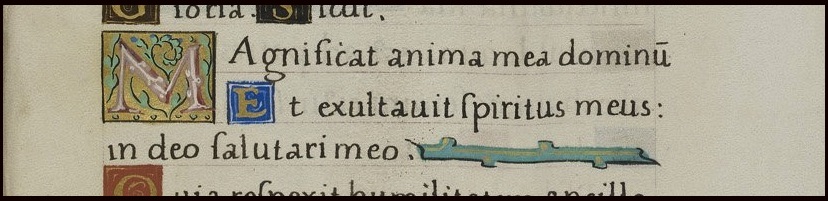
Detail of Psalm 150 and the Magnificat, "The Psalter of King Henry VIII" (England, 16th c.)

My soul doth magnify the Lord,
    and my spirit hath rejoiced in God my Savior. 
For he hath regarded
    the lowliness of his handmaiden. 
For behold from henceforth
    all generations shall call me blessed. 
For he that is mighty hath magnified me,
    and holy is his Name. 
And his mercy is on them that fear him
    throughout all generations. 

On her visit with Elizabeth, Mary magnifies the Lord who has magnified her.  Joyfully she confesses, “Great is the Lord, and highly to be praised” (Ps. 48:1), turning to her Creator in love and praise as she was created to do, acting as the new Eve.  She magnifies the Lord who has magnified his mercy with her (Lk. 1:58), his servant, and with her his chosen people, and through his servant Israel the whole creation.  Bearing the Lord in her womb, all creation rejoices in her as she sings to the Most High who regards the lowly (Ps. 131:6).  “O magnify the Lord with me, and let us exalt his name together,” she sings (Ps. 34:3).

He hath showed strength with his arm;
    he hath scattered the proud in the imagination of their hearts. 
He hath put down the mighty from their seat,
    and hath exalted the humble and meek. 
He hath filled the hungry with good things,
    and the rich he hath sent empty away. 

Like Hannah, Mary praises “the Lord, mighty in battle” (Ps. 24:8), who “makes poor and makes rich; he brings low, he also exalts” (1 Sam. 2:7).  She is ecstatic because “things shall not remain as they are,” for in her Son the God of Israel works to “exalt that which is low” and “abase that which is high” (Ezek. 21:26).  The Mighty One “bares his holy arm” (Isa. 52:10) to renew his creation, the devastation of which is evidenced insofar as “the wicked prowl on every side, and that which is worthless is highly prized by everyone. (Ps. 12:8)  “Things shall not remain as they are”—with the proud swollen in conceit, loving themselves to the point of hating their Creator—because the King of Heaven “is able to bring low those who walk in pride” (Dan. 4:37).  “Things shall not remain as they are”—with the ‘mighty’ on their thrones disregarding the Almighty, committing violence and oppressing the poor—because the Lord “pours contempt on princes…but he raises up the needy out of distress” (Ps. 107:40–41).  “Things shall not remain as they are”—with the rich stuffing themselves with what they think is their own, depriving of justice the poor who lie like Lazarus at their gates, covered with sores and licked by dogs (Lk. 16:19–21)—because the Truth will speak truly, “Blessed are you who are poor, but woe to you who are rich” (6:20, 24).  “Things shall not remain as they are,” because Mary’s Son, her Lord, is “making all things new” (Rev. 21:5).

He remembering his mercy hath holpen his servant Israel,
    as he promised to our forefathers,
    Abraham and his seed for ever.

Mary rejoices because in her the God of Israel has again shown forth his steadfast love, showing himself to be the faithful God who keeps covenant (Dt. 7:9).  She rejoices because the One who said to his servant Israel, “Do not fear, for I am with you” (Isa. 41:10), says to her through his messenger, “The Lord is with you” (Lk. 1:28).  She rejoices because her Son will be given “the throne of his ancestor David...and his kingdom will have no end” (1:32–33).  She rejoices because she bears in her womb “the root of Jesse” (Isa. 11:10), the mighty savior the Lord God of Israel has raised up to fulfill his promise to rescue his people from the hands of their enemies that “they might serve him without fear, in holiness and righteousness” (Lk. 1:68–75).


Sing aloud, O daughter Zion;
   shout, O Israel!
Rejoice and exult with all your heart,
   O daughter Jerusalem!
The Lord has taken away the judgements against you,
   he has turned away your enemies.
The king of Israel, the Lord, is in your midst;
   you shall fear disaster no more. 
[…]
he will rejoice over you with gladness,
   he will renew you in his love;
he will exult over you with loud singing 
   as on a day of festival.  (Zeph. 3:14–15, 17)

Sing aloud, O Mary, for in you the Lord has drawn the creation to himself.  Rejoice and exult with all your heart, and let the whole creation sing together with you for joy
at the presence of the Lord, for he is coming
     to judge the earth.
He will judge the world with righteousness,
     and the peoples with equity. (Ps. 98:7–9)

08 April 2013

On the Ustyug Annunciation

Today is the Feast of the Annunciation, transferred from Holy Week.  To mark the day, here is a reflection on one of my favorite icons: the Ustyug Annunciation.

"Annunciation Ustyuzhskoe," Novgorod icon (12th c.), Tretyakov Gallery
“The angel Gabriel was sent by God to a town in Galilee called Nazareth, to a virgin engaged to a man whose name was Joseph, of the house of David. The virgin’s name was Mary.  And he came to her and said, ‘Greetings, favored one! The Lord is with you’.” — Luke 1:26–28
Gabriel comes as the messenger of the one who says, “Sing and rejoice, O daughter Zion! For lo, I will come and dwell in your midst” (Zech. 2:10).  Gabriel greets her within whose womb his Creator (and hers) comes to take on flesh.  In the icon, Gabriel’s hand is raised in blessing because he comes in “the fullness of time” to “a woman” (Gal. 4:4) who has “found favor with God” (Lk. 1:30), to the one who will become Mater mundi Salvatoris, Mother of the world’s Savior.*  Gabriel rejoices with all creation† in the one chosen in God’s “good pleasure” (Eph. 1:5, 9) to be the mother of the Son of God.

“Then Mary said, ‘Here am I, the servant of the Lord; let it be with me according to your word’.” — Luke 1:38
Like Abraham (Gen. 22:1), like David (Ps. 40:7), like her Son (Heb. 10:5–7), Mary’s response to the Lord is: “Here I am.”  She gives herself totally to the Lord.  In delighting to do the good pleasure of God’s will (Ps. 40:8; Eph. 1:5), she is made the mother of Christ, bearing him in her heart whom she will conceive in the flesh.‡  Thus, in the icon, she touches her heart, wherein dwells Christ, the King of Glory, who also makes her womb a throne.

In the icon, the Virgin Mary also holds scarlet thread in her hands.  The imagery comes from an apocryphal story in which Mary is chosen to spin scarlet and purple thread for the veil for the Temple.§  Apocryphal or not, it seems an appropriate symbol in the hands of her from whom “the Word became flesh and lived, tabernacled, among us” (Jn. 1:14).  Her flesh becomes “the temple of his body” (Jn. 2:21), and, in his face, shines forth with the glory of God (2 Cor 4:6).
Rejoice and be glad, O Virgin Mary, Alleluia. For the Lord has truly risen, Alleluia.    — Regina Coeli antiphon

* From Henryk Gorecki, Totus tuus Op. 60.
† From the Divine Liturgy of St. Basil the Great:  “In you, O full of grace, all creation rejoices, the ranks of Angels and the human race: hallowed temple and spiritual Paradise, pride of virgins, from whom God was made flesh; and he, who is our God before the ages, became a little Child; for he made your womb a throne; and made it wider than the heavens. In you, O full of grace, all creation rejoices. Glory to you!”
‡ Augustine, De sancta virginitate 3.3
§ Protoevangelium of James 10.

26 March 2013

The Seven Last Words of Christ: The Third Word

“Woman, behold your son! … Behold your mother!”
John 19:26–27

The Crucifixion, Icon, 15th c., Andrei Rublev Museum Moscow

Lord Jesus, eternally begotten of the Father, you were formed in the womb of your mother to be his servant (Isa. 49:5).  You are the Word he speaks, and when you took on your mother’s flesh, you heard him say to you, “You are my servant, Israel, in whom I will be glorified” (Isa. 49:3).  Before the hour had come for you to be glorified, she knew you would provide wine at the wedding feast; your mother told the servants to do whatever you told them (Jn. 2:5), because she had already said, “Here I am, the servant of the Lord; let it be with me according to you word” (Lk. 1:38, cf. 8:21).  She bore you in her womb and nursed you, and, although not even your brothers believed in you (Jn. 7:5), your mother followed you to the cross.  When your hour had come, and you were lifted up “to raise up the tribes of Jacob and to restore the survivors of Israel” (Isa. 49:6), she was standing near your cross.  She did not love her life, but followed you; where you were, there your servant was also (12:25–26).  Your mother received you, in whom is life, and you gave her power, through your Spirit, to become a child of God, to be “born from above” (Jn. 1:12; 3:3).  You call her, “Woman,” because, through you, she “has received a spirit of adoption” by which she cries, “‘Abba! Father!’,” bearing witness that she is a “joint heir” with you (Rom. 8:15–17).

Your mother did not come alone to stand near your cross; three other women—your “mother’s sister, Mary the wife of Clopas, and Mary Magdalene”—were standing beside her, along with one man—the disciple whom you loved (Jn. 19:25–26).  Lord Christ, in your humble obedience, even on the cross, you did not look to your own interests, but to the interest of your mother and your beloved disciple (Phil. 2:4). You arranged that he should care for her as his mother, and take her into his own home (Jn. 19:27).  When you tell him, “Behold your mother!”, you reveal to him that your natural mother is his spiritual mother, because she is your first disciple.*  You are “in the bosom of the Father” (Jn. 1:18), and your beloved disciple reclined next to your heart at the supper in the Upper Room.  You make him, whose only relation to you is love, the son of your mother, who gave you her flesh.  Son of Mary, Son of God, you were lifted up from the earth “as a light to the nations” (Isa. 49:6) to draw all people to yourself (Jn. 12:32):
O the depth of the riches and wisdom and knowledge of God! How unsearchable are his judgements and how inscrutable his ways! To him be the glory for ever and ever. Amen.  (Rom. 11:33, 36)

* Cf. Raymond Brown, The Death of the Messiah, vol. II.